Interaction
Author: Liang Wen, Assistant Professor, Department of Strategic Management and Organisation (SMO), IBSS
Abstract:
Class discussions are widely used in higher education to support active learning, peer interaction, critical thinking, and student engagement, both in tutorials and lectures. However, in medium and large classes, instructors often find it difficult to collect, compare, and respond to multiple student or group contributions within limited class time, meaning that valuable ideas may remain unseen. To address this challenge, our EASE project developed and piloted DialogueHub, an AI-augmented collaborative dialogue platform designed to enhance classroom interaction. The platform enables students to submit individual or group responses digitally during class. These submissions are then automatically aggregated, summarised, and analysed, helping instructors identify common themes, divergent views, knowledge gaps, and areas requiring further clarification in real time. The pilot showed that DialogueHub improved classroom efficiency, encouraged broader participation, and supported more responsive teaching. Students could better understand how their ideas connected with the wider class discussion, while instructors gained immediate insights into class-wide understanding. This article presents the project design, implementation, outcomes, challenges, and recommendations for future scaling, arguing that lightweight AI tools can meaningfully enhance classroom discussion when aligned with pedagogy, learning needs, and instructor judgment.
Keywords: Class discussions, AI-enhanced learning, collaborative dialogue platform
Introduction
Collaborative learning is an important part of contemporary higher education. In business and management education, class discussions, case analysis, problem-solving tasks, and reflective dialogue are commonly used to help students move beyond passive learning. Through discussion, students can express ideas, compare perspectives, challenge assumptions, and apply theoretical concepts to practical problems. These activities are particularly valuable in management modules, where many questions involve ethical dilemmas, organisational behaviour issues, strategic trade-offs, and decision-making under uncertainty.
However, effective class discussion can be difficult to manage, especially in medium or large classes. When many students or groups discuss a question at the same time, instructors may not be able to capture all responses within limited class time. As a result, only a few voices may be heard, quieter students may be underrepresented, and valuable ideas may remain invisible. Instructors may also find it difficult to identify class-wide patterns, such as common misunderstandings, shared viewpoints, divergent perspectives, or areas where students require further explanation.
These challenges motivated our EASE project, The Collaborative Dialogue Platform: Enhancing Class Interaction. The project explores how AI can support, rather than replace, the instructor’s facilitation role. The platform developed through the project, now named DialogueHub, acts as an analytical assistant for classroom discussion. It collects individual or group responses, organises and summarises them, and provides real-time analysis to support more informed teaching decisions. DialogueHub can be used in both tutorials and lectures. It supports up to 200 concurrent users and transforms multiple student submissions into structured AI-generated summaries and insights, enabling instructors to understand student thinking more quickly and provide more targeted feedback during class.
Platform Design
The project was conducted in the Department of Strategic Management and Organisation (SMO) at IBSS, with support from Learning Mall. As a module-level EASE project, it brought together academic and technical team members to integrate pedagogical design with platform development. The project aimed to improve the quality and efficiency of classroom discussions in both tutorials and lectures, particularly in management modules where students frequently engage with open-ended questions, case analysis, ethical dilemmas, and strategic decision-making tasks.
Traditional discussion methods, such as paper-based responses or oral group reporting, remain useful but have clear limitations in medium and large classes. When many individuals or groups contribute at the same time, instructors may only hear from a small number of students, leaving many ideas unseen. This makes it difficult to identify class-wide understanding, common misconceptions, and diverse perspectives in real time. The project therefore began with a practical pedagogical question: How can AI help instructors capture, analyse, and respond to student discussion outputs more effectively during live teaching?
To address this question, the team developed DialogueHub as a web-based platform for real-time classroom interaction. Instructors can create discussion sessions with a title, password, date, duration, and agenda. Students can then join the session through a QR code or direct link and submit responses individually or in groups. The platform also supports the upload of relevant teaching materials, such as discussion questions, case documents, tutorial materials, or model answers. Once responses are submitted, DialogueHub uses AI to summarise key arguments, identify common themes, compare similarities and differences across responses, detect divergent views, highlight unique points, and suggest prompts for follow-up discussion. This allows instructors to make quicker and more informed teaching decisions during class.
Practical Application Example
1. Session Setting
A key feature of DialogueHub is the Quick AI Creation function, which allows instructors to generate a structured class discussion session from a simple prompt. This function reduces preparation time and helps instructors organize interactive learning activities more efficiently.
For example, an instructor may enter the following prompt:
“Arrange a 50-minute tutorial discussion for SMO302 TTL6 on Organisation Development Interventions: People and Process. Include a 5-minute video watch, 15 minutes for discussion and group submission, and 30 minutes for reflection. Schedule for July 10, 2026, from 14:00 to 14:50.”
Based on this prompt, the platform can create a discussion session with a clear agenda, timing, and access information. Students can then join the session through a QR code or direct link and submit their responses individually or in groups.
Figure 1 (a). Instructor Interface in DialogueHub
Figure 1 (b). Student Interface in DialogueHub
2. Discussion Question and Student Responses
In one classroom activity, students were asked to discuss the following question:
“What is your opinion on pay secrecy?”
Students submitted their responses through the platform. For example:
After collecting the responses, DialogueHub automatically summarised and analysed the submissions. The platform identified that both groups viewed pay secrecy as a double-edged issue with both advantages and risks. It also highlighted the difference between the two responses: the first group focused more on interpersonal dynamics, such as workplace jealousy, while the second group emphasised broader systemic concerns, such as discrimination and fairness.
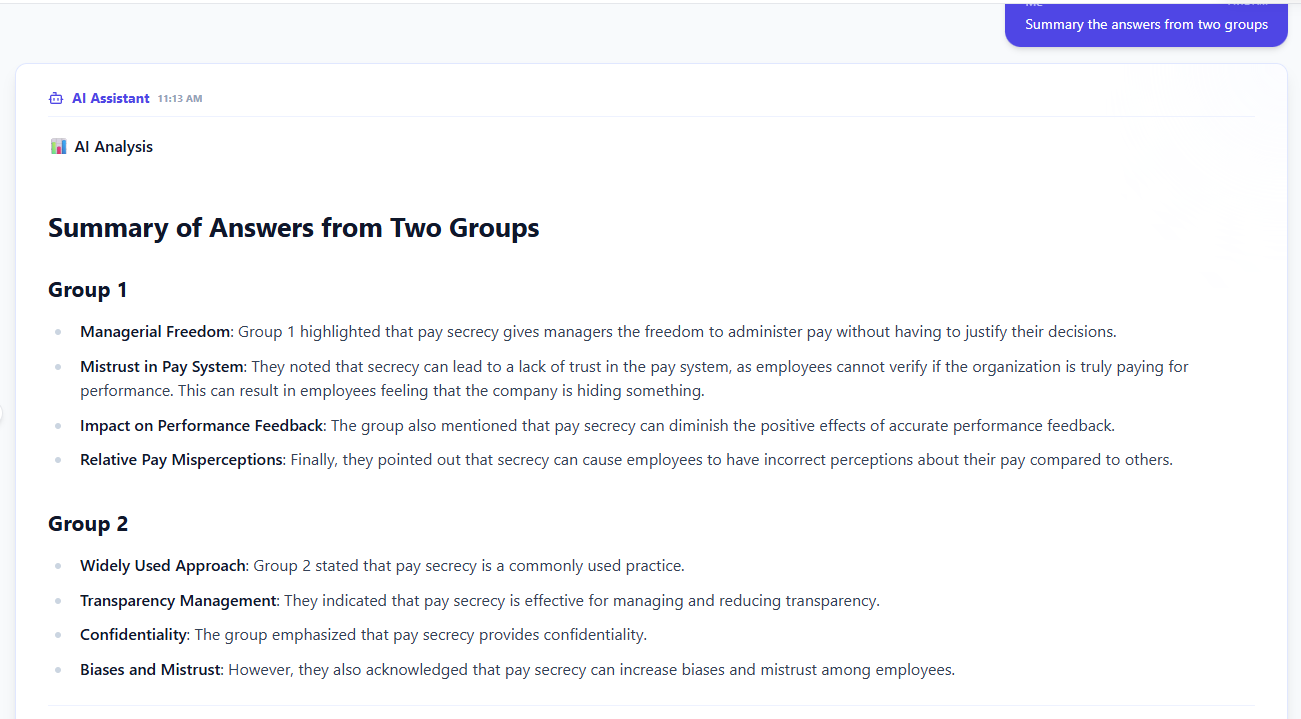
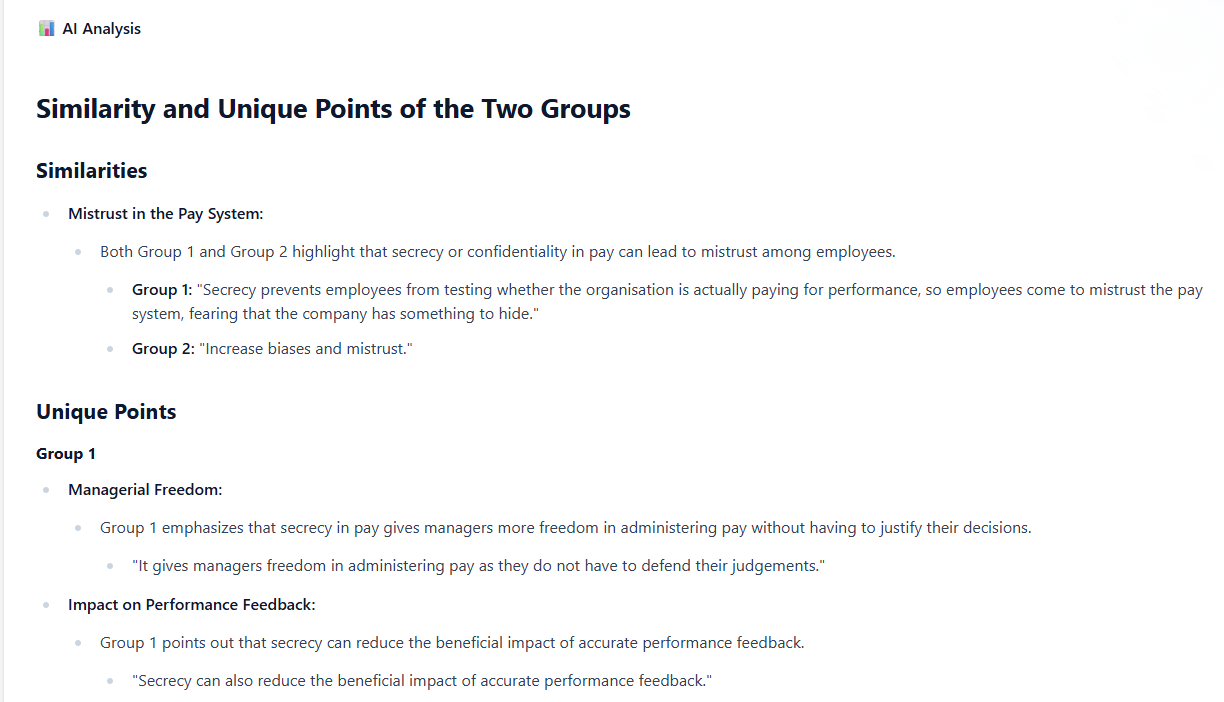
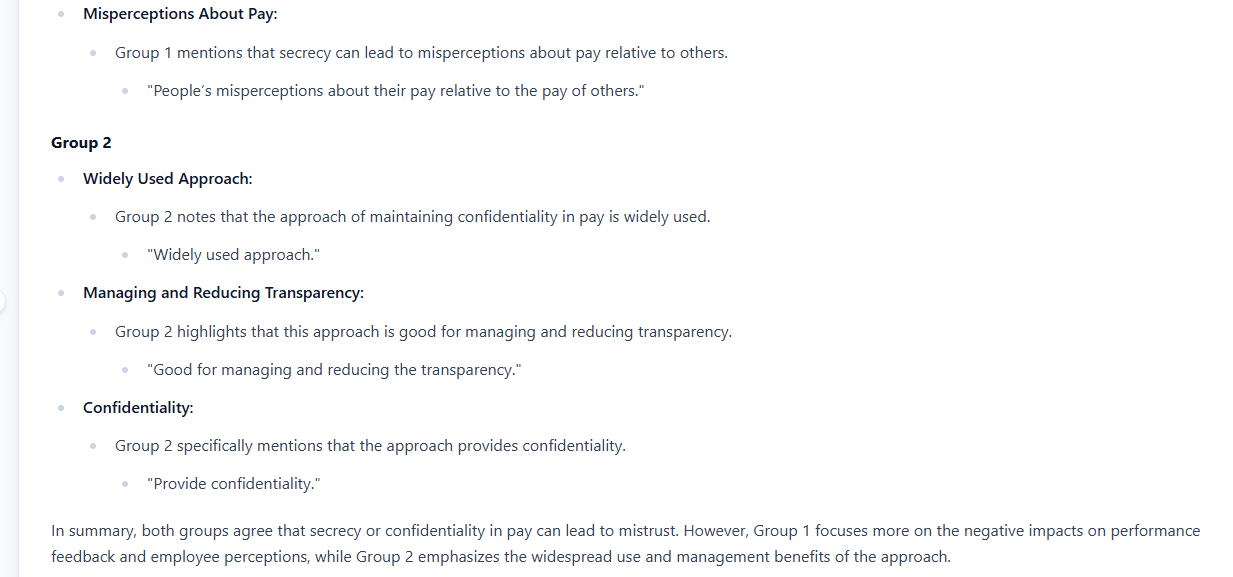
This AI-generated analysis helps the instructor move quickly from raw student responses to meaningful classroom discussion. Instead of spending several minutes reading each group’s answer aloud, the instructor can immediately identify key themes, compare perspectives, and ask targeted follow-up questions. For example, the instructor may ask students to consider whether pay transparency creates more fairness or more tension, or whether the answer depends on organisational culture, legal context, or HR policy design. In this way, DialogueHub supports more efficient, inclusive, and evidence-informed classroom interaction.
Insights from the Pilot
The DialogueHub project followed an iterative process, moving from classroom needs analysis to platform development, pilot testing, and reflection. Instead of positioning AI as a chatbot or content generator, the team designed DialogueHub as a structured dialogue assistant that makes student-generated responses more visible, comparable, and usable. Its lightweight web-based design, QR code access, support for individual and group submissions, and real-time analytical dashboard made it practical for live teaching contexts. The classroom pilot confirmed that students could use the platform with minimal technical barriers, while instructors could integrate AI-generated summaries into discussion facilitation.
The project also generated important educational insights. For students, DialogueHub created a more inclusive discussion environment by ensuring that all individual or group responses could be captured, not only those shared orally. It also helped students see how their ideas related to wider class patterns, supporting reflection and metacognitive learning. For instructors, the platform reduced the administrative burden of collecting and comparing responses, allowing more time for interpretation, clarification, and targeted follow-up questions. At the module level, DialogueHub supported more consistent active learning across teaching groups and provided useful evidence for future curriculum improvement. At the same time, the pilot highlighted areas for further development, especially multi-round discussion functions and more advanced visualisation features.
Teaching Tips
For instructors adopting AI-supported discussion tools such as DialogueHub, the first step is to begin with a clear pedagogical purpose. Instructors should decide what they want students to discuss, what kind of responses they expect, and how the AI-generated summary will be used during class. The platform is most effective when discussion questions invite comparison, evaluation, justification, and application. For example, questions such as “What are the advantages and disadvantages of pay secrecy?”, “Which organisational development intervention would be most appropriate in this case, and why?”, or “How would you interpret this management problem from different theoretical perspectives?” are likely to generate responses that can be meaningfully compared and synthesized.
It is also important to explain to students how their responses will be used. Students are more likely to engage seriously when they understand that their submissions will shape the subsequent class discussion, rather than simply being collected for monitoring purposes. Instructors can make this clear by telling students that the platform will help identify common themes, interesting differences, and questions for further discussion. This transparency helps students see their contributions as part of a collective learning process.
A second practical tip is to treat AI output as a starting point rather than a final answer. AI-generated summaries can help instructors identify patterns quickly, but they should not be treated as complete, neutral, or always accurate. Instructors should review the analysis critically, correct inaccuracies where necessary, and use their disciplinary expertise to guide the discussion. This is particularly important in management education, where student responses often involve judgement, interpretation, and context-sensitive reasoning rather than simple right or wrong answers.
Finally, instructors should close the feedback loop. After students submit their responses, it is important to show how these contributions shaped the class conversation. For example, the instructor might say, “Several groups raised the issue of fairness,” or “One interesting difference is that some groups focused on privacy, while others focused on discrimination.” This helps students feel that their participation matters and encourages more thoughtful engagement in future activities. Over time, such practices can help build a stronger classroom culture of dialogue, reflection, and shared inquiry.
Reflection and Conclusion
The DialogueHub project offers several broader reflections on the role of AI in higher education. Its value lies in addressing a real pedagogical problem: the difficulty of capturing, synthesising, and responding to multiple student contributions during live discussion. In this project, the challenge was not a lack of teaching content, but a lack of visibility and synthesis in classroom interaction. DialogueHub helped address this issue by making student thinking more accessible to instructors and peers. Rather than replacing the instructor, the platform supports teaching by processing student responses quickly and highlighting patterns that may otherwise be missed.
The project also shows that AI can support more inclusive participation when it is carefully designed and pedagogically guided. By allowing all groups to submit ideas, DialogueHub reduces reliance on a few vocal students and gives instructors access to a broader range of perspectives. However, inclusiveness does not come from technology alone. It also depends on classroom culture, question design, instructor facilitation, and students’ trust in how their contributions will be used. Therefore, instructors should explain the purpose of the platform, encourage respectful discussion, and create a learning environment in which students feel comfortable contributing.
Another important reflection concerns AI literacy. Both teachers and students need to understand the strengths and limitations of AI-generated analysis. AI can summarise, classify, and compare responses efficiently, but it may also oversimplify arguments, miss contextual nuance, or generate inaccurate interpretations. For this reason, instructor judgment remains central. The platform should be understood as a teaching support tool, not as an authority. Its role is to assist human interpretation, not to replace it.
In conclusion, DialogueHub demonstrates how AI can be used in a practical and pedagogically meaningful way to enhance group-based tutorial interaction. By supporting digital submission, real-time aggregation, and AI-powered analysis, the platform helps instructors capture a wider range of student ideas and provide more targeted feedback during class. The pilot produced positive outcomes for student participation, instructor facilitation, and module-level teaching enhancement. At the same time, it revealed areas for future development, especially multi-round discussion, stronger visualisation, integration with existing learning systems, and staff training. Overall, DialogueHub is a promising example of AI-enhanced teaching innovation. Its value lies not in automating education, but in strengthening the connection between student participation, instructor judgment, and collaborative learning.
Appendix
Access link to DialogueHub (currently named “Meeting AI”):
https://meeting-edu.yunjiai.cn/
EASE Project Team members: Liang Wen (PI, from SMO), Xiaoyan Liang (CI, from SMO), Yan Pan (CI, from Hexie), and Han Xin (CI, from Learning Mall)


