
Bridging Disciplines and Digital Tools: An ALC Lecturer's Journey with XIPU AI in the MTH128 Tutorial
Abstract
This reflective practice article details the experience of an embedded Academic Literacies Centre (ALC) lecturer in designing and delivering tutorials for MTH128: Bridging Math, Physics, and Entrepreneurship, a novel interdisciplinary module. Faced with the multifaceted challenges of mastering unfamiliar content, designing engaging activities, and scaffolding complex assessments while integrating English for Specific Academic Purposes (ESAP) skills, the lecturer employed XIPU AI as a strategic co-pilot. Through three illustrative case studies, the article demonstrates how AI was used to decode complex concepts, design class activities and deconstruct assessments. The article reflects on the impact of this approach, noting gains in teacher efficacy and student learning, while also critically engaging with key AI challenges such as factual inaccuracy. It concludes by proposing “augmented practice” as a sustainable model, where AI acts as a tool that enhances, rather than replaces, the specialist EAP teacher’s role.
Keywords: English for Specific Academic Purposes (ESAP), Embedded Academic Literacy, Generative AI in Education, Interdisciplinary Pedagogy
1. Introduction
MTH128 (Bridging Math, Physics, and Entrepreneurship) is a brand-new module for Year 2 undergraduates in the School of Math and Physics (SMP) which bridges analytical methods with entrepreneurship. It uses case studies and team projects to develop skills in identifying opportunities, analyzing markets, and designing business models. In terms of learning and teaching, this module combines lectures on fundamental entrepreneurial and analytical concepts with tutorial sessions (MTH128 Module Handbook, 2025).
As part of the Global Cultures and Languages Hub (GCLH) at XJTLU, the Academic Literacies Centre (ALC) was established in 2025 to support all academic departments with English language and academic skills. ALC lecturers are embedded in departments to provide topic- and skills-specific support to students. I am a member of the ALC, embedded in the SMP, and was responsible for delivering the MTH128 tutorial sessions to students across Applied Mathematics, Financial Mathematics, and Actuarial Science in Semester 1 of AY2025-26.
The MTH128 tutorial sessions aim to review the main points of the lecture and reinforce learning through group work and relevant activities. More importantly, they must explicitly support students in developing the skills required to successfully complete the assessment tasks. Furthermore, tutorial lecturers from the ALC are tasked with enhancing students’ ability to use English in business contexts, such as reading case studies, writing business plans, and delivering presentations.
The challenges of teaching this unique interdisciplinary module are multifaceted. First, as an EAP specialist without a formal background in math or business, I faced the immediate hurdle of mastering unfamiliar and complex content quickly and accurately to establish credibility and provide meaningful support. Second, I needed to design tutorial activities that created a logical and coherent bridge between the weekly lecture material and the practical application required for assessments. Third, it was crucial to foster student engagement, particularly as many questioned the relevance of the business-focused content to their primary mathematics or physics studies. Finally, and most critically, all of this had to be achieved while seamlessly integrating English for specific academic purposes (ESAP) skills.
This article details how the strategic application of XIPU AI empowered me, as an embedded EAP practitioner, to navigate the multifaceted challenges of teaching the interdisciplinary MTH128 module. It first contextualizes these challenges within ESAP pedagogy, then presents case studies illustrating how AI was used in decoding complex concepts, designing class activities and deconstructing assessments. Finally, it reflects on the implications of this augmented practice for teacher development, student learning, and the ethical integration of AI in specialized education.
2. Literature and Context:
English for Specific Academic Purposes (ESAP) focuses on teaching the unique language and communication styles of a particular subject area (Hyland, 2022). This means moving beyond general academic English to focus on the real-world texts, vocabulary, and ways of arguing used within a specific field (Hyland, 2022). For an EAP teacher working within a department like Math and Physics, this creates a dual role. We are not content experts, but rather specialists in academic communication who must quickly learn about the discipline in order to support students effectively. In this model, the EAP practitioner acts as a “discourse analyst”, deconstructing the texts and presentations of the discipline, and a “scaffolder”, designing step-by-step activities that guide students towards mastery of these forms (Wingate, 2012). Our expertise lies not in possessing specialist knowledge, but in facilitating students’ ability to communicate it with clarity and precision.
The MTH128 module, however, presented the specific and multifaceted challenges outlined in the introduction, testing the ESAP model. My job was to quickly learn and then help students use a brand-new, blended form of communication that many saw as unrelated to their program studies. This combined the models of math, the theories of business, and the academic skill of presenting an idea. On top of that, I had to design engaging tutorials that clearly connected lecture topics to the assessments, all while actively building the specific English skills students needed for their posters and presentations. In essence, I was not scaffolding one established subject but facilitating a new and interdisciplinary one. This demanded that I, as the facilitator, first map this uncharted interdisciplinary territory myself before I could guide students through it.
This is where modern technology offered a solution. Recent educational research suggests that generative AI should be seen not as a replacement for teachers, but as a collaborative tool - a partner for idea generation, content simplification, and pedagogical design (Zhai et al., 2021). For example, Kasneci et al. (2023) highlight its potential as a "practice partner" for educators. For embedded EAP practitioners facing the need to rapidly acquire proficiency in unfamiliar disciplinary content, this tool proved invaluable. It provides an efficient means of bridging knowledge gaps, generating teaching ideas and creating teaching materials, thereby allowing me to focus on my core professional responsibilities such as curriculum design and delivering feedback. My journey in MTH128, therefore, represents a practical case study in the intersection of traditional ESAP pedagogy and the emergent possibilities of AI-augmented instruction.
3. Case Studies from the Tutorial Classroom
3.1 Case Study 1: Using XIPU AI to decode Complex Concepts
My first and most immediate challenge was to confidently explain the module’s core entrepreneurial concepts, which were entirely new to me and to many of my math-focused students. To close my own knowledge gap and create a clear bridge from the lecture, I leveraged XIPU AI as a clarifier, turning dense terminology into accessible learning points.
A primary example was unpacking the key distinction between source innovation (creating a new market or need) and flow innovation (improving existing solutions). The definitions from the lecture were abstract, so I prompted the AI: “Can you explain ‘source innovation’ and ‘flow innovation’ to a middle school student? Make the concept simple and give examples.” I asked the AI to explain the concepts to "a middle school student" to force a simple explanation with clear examples. The AI produced a concrete analogy: source innovation is like creating a whole new drink, such as strawberry lemonade, by using a new ingredient. Flow innovation is like improving how students share ideas - switching from passing notes to using a group chat to communicate faster and easier (see Image 1). This simple, concrete analogy became the centrepiece of my tutorial review. It not only cemented my own understanding but gave students a memorable mental model, allowing us to quickly move to more complex, discipline-specific applications, such as discussing source and flow innovation in the real business world.
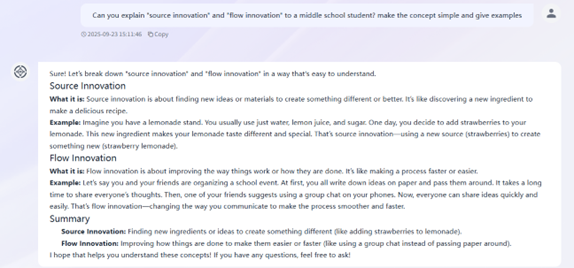
Image 1
Beyond definitions, students struggled to see how “mathematical thinking” translated into real-world entrepreneurial success. To bridge this gap, I used XIPU AI as a research assistant, asking it to generate an article about Jim Simons along with reading comprehension questions (see Image 2). The AI provided a concise summary of Simons’s quantitative hedge fund and produced questions such as, “Why do you think using mathematical models can be better than relying on human guesses in investing?” This tailored case study served a dual purpose: it validated the module’s core premise by framing mathematics as a potent entrepreneurial tool, and it provided relevant material for students to practice the analytical reading essential for academic skill development. The AI-generated questions then scaffolded a focused class discussion, directly linking the weekly theme to a tangible, high-profile example.
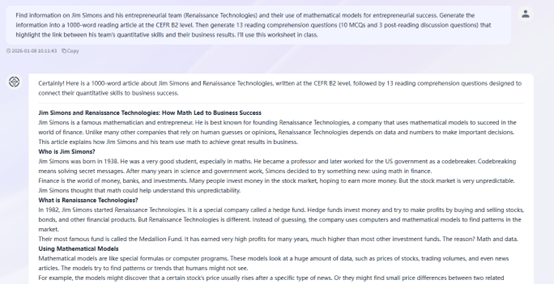
Image 2
3.2 Case Study 2: Using XIPU AI to design active learning
With a foundational grasp of the content secured, the next challenge was to translate these concepts into engaging, student-centred activities. The module’s success depended on students actively practicing the innovative thinking it promoted. Here, I leveraged XIPU AI as a creative partner to rapidly prototype and refine interactive pedagogical designs that would make abstract thinking styles tangible and relevant.
A lecture on the four types of innovative thinking - divergent, convergent, associative, and critical - risked remaining theoretical without application. To move from definition to practice, I prompted the AI: “Generate a short, simple, 10-minute classroom activity for each of the four thinking types (divergent, convergent, associative, critical). Each activity should be relevant to mathematics students and relate loosely to product or business idea generation” (see Image 3). These prompts were perfectly pitched. They were rooted in the concepts that students are familiar with while effectively pushing students into an entrepreneurial mindset for idea generation. I adapted these suggestions into a fast-paced tutorial station rotation, giving students concrete experience in mentally shifting between these different thinking modes.
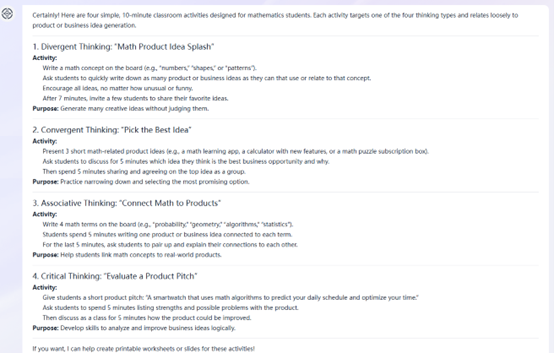
Image 3
For more sustained engagement, I needed compelling, hands-on tasks. I turned to AI to brainstorm and detail these experiences. First, I asked: “Suggest a practical, 30-minute group activity to practice using Osborn’s 9-point checklist for idea modification, using a simple, available object.” The AI proposed the “Water Bottle Activity,” where groups take a standard water bottle and apply checklist questions like “Modify?” (Could its shape be changed?) or “Put to other uses?” (Could it be used as a tool?). It provided a full facilitator script (see Image 4). These AI-generated blueprints provided a robust, ready-to-use structure that I could then personalise, saving hours of design time while ensuring pedagogical soundness.
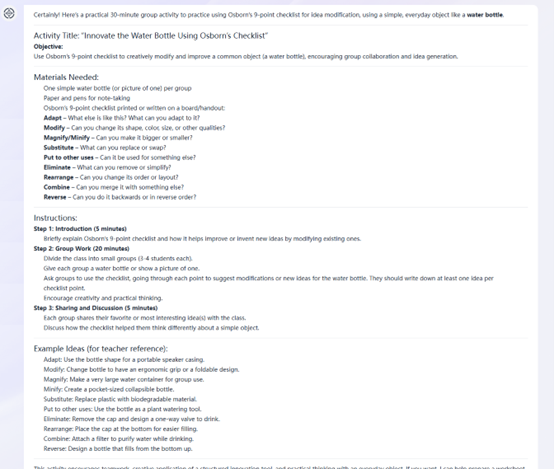
Image 4
3.3 Case Study 3: Using XIPU AI to deconstruct assessments
The ultimate test of the tutorials was their efficacy in preparing students for the module's dual assessments: a group poster outlining a business model and plan, and an individual presentation based on that poster. My role was to demystify the detailed requirements on the task sheets and provide targeted support for success. To do this, I engaged XIPU AI as a co-scaffolder, using it to deconstruct the assignment briefs and generate explicit, discipline-specific frameworks that would guide students from confusion to confidence.
The formal assessment task sheets, dense with academic and business terminology, presented a significant initial barrier for students. My first step was to leverage the AI as a translator of these complex documents. For instance, I uploaded a screenshot of the poster’s core requirements and prompted: “Analyse this poster assessment requirements. Use simple terms and examples to explain what should be included in the business model section. Specifically, clarify the meaning of the terms ‘content’, ‘structure’, ‘governance’, and ‘value logic’.” The AI responded with a clear breakdown, explaining each term through the relatable example of “a healthy breakfast delivery service” (see Image 5). This output allowed me to transform the task sheets into concrete, student-friendly guidelines, effectively bridging the gap between assignment expectations and student understanding.
Image 5
Beyond explaining the “what,” students needed a model of the “how” - how to structure a compelling 4-minute presentation that followed the requirements of the task sheet. I provided the suggested structure of the presentation to the AI and prompted: “This is the suggested structure of a 4-minute presentation. Generate a clear and actionable outline with specific headings, sub-points for content, and crucial signposting language”. The AI produced a coherent skeleton, structuring the presentation into five distinct parts that aligned precisely with the task sheet's specifications (see Image 6). This outline served not as a template to copy, but as a scaffolded model that visually mapped the expected structure and flow of an academic presentation. In class, we used this model to discuss the fundamental anatomy of a presentation and how to employ effective signposting language to guide the audience. This process demystified the assessment and empowered students to focus their efforts on developing strong content within a clear, confident structure.
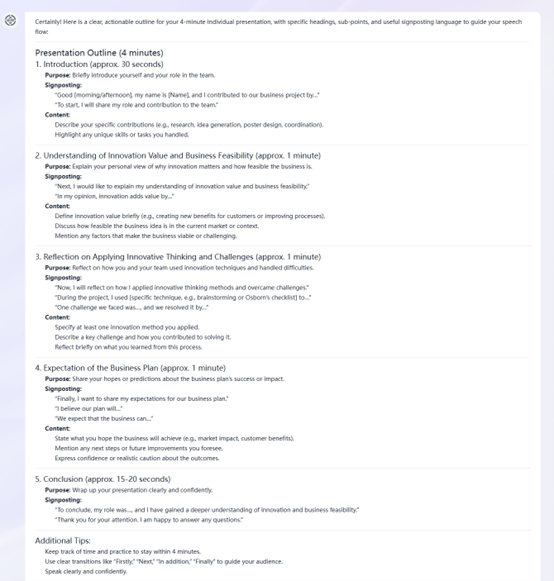
Image 6
4. Reflection and implications
4.1 For the teacher
The most profound impact was on my own identity and efficacy as an embedded EAP practitioner. Initially, the challenge of teaching outside my expertise created considerable anxiety - specifically, the worry that students would pose detailed questions on mathematics or business that I could not answer. XIPU AI fundamentally alleviated this barrier. By acting as a real-time explainer and idea generator, it did not transform me into a subject expert, but it empowered me to become a more confident and adaptable facilitator of interdisciplinary discourse.
This shift was transformative. Instead of spending long hours struggling to decode unfamiliar materials, I could reinvest that time into more meaningful pedagogical tasks: designing the learning journey, anticipating student misconceptions, and planning for differentiated language support. The AI handled the initial heavy lifting of content processing; my role was to curate, adapt, and contextualise its outputs for my specific students. Consequently, my position evolved from a potential bottleneck of knowledge to a conductor of learning processes. This experience has redefined my understanding of embedded practice: mastery is not about knowing all the content, but about mastering the tools and methods to make any content accessible and actionable for students.
4.2 For students
The ultimate measure of success was student learning, and several positive outcomes were observable. First, there was a notable increase in the clarity and coherence of assessment submissions. Student posters and presentations demonstrated greater structural coherence, as the sections outlining the business model, innovation techniques, and financial projection were more clearly defined and logically connected. This indicated that the AI-scaffolded outlines and genre explanations had successfully translated vague requirements into a comprehensible guide.
Second, the quality of in-class discussions and questions improved. When core concepts were clarified through AI-generated analogies like the lemonade stand, students spent less time confused by basic terminology and more time engaging in higher-order application, such as how to use a math principle to create a business opportunity. AI-designed activities such as the water bottle innovation challenge, created genuine energy and teamwork in the classroom, demonstrating that well-designed, relevant tasks could overcome initial doubt about the module's relevance. Informal feedback from students in class included comments such as, “The tutorials helped me connect the lecture theory to what we actually had to do.” This suggests that students perceived the AI-assisted lessons as effectively bridging the gap between abstract concepts and practical assignments.
4.3 Awareness of AI’s limitations
This positive experience, however, was built on a foundation of critical engagement, not uncritical adoption. Recognising AI’s limitations is paramount to using it ethically and effectively.
The primary pitfall is the risk of “hallucination” or “confident inaccuracy”, where AI generates plausible but incorrect or fabricated information (Kasneci et al., 2023). For example, when it was asked to explain “the four dimensions of innovation”, it provided an answer that was not aligned with the content of the lecture. To mitigate this risk and ensure reliability, I established a verification protocol. Any AI-generated explanation (e.g., of ‘value logic’ in a business model) was never taken at face value. I systematically cross-referenced it with the primary source materials - the official lecture slides, core readings, and the module handbook. In cases of ambiguity or complex technical points, I consulted directly with the lead MTH128 lecturer, transforming potential knowledge gaps into opportunities for collaboration and ensuring disciplinary accuracy. Furthermore, I transparently discussed this checking process with students, modelling digital literacy and critical source evaluation alongside module content.
Second, the depth of understanding required for interdisciplinary teaching presents a challenge. Complex concepts in math and business cannot be mastered from a single AI-generated paragraph. To smooth the foundational knowledge gap, I used AI not as an answer box but as a dynamic explanation tool. For instance, when preparing a session on the entrepreneurial application of mathematical models, I needed to understand the core concept behind Jim Simons's success. A simple query about “quantitative hedge funds” yielded a jargon-heavy answer. I then prompted iteratively: “Use an analogy to explain how a quantitative trading model identifies opportunities to a non-expert.” The AI compared it to a weather model that finds patterns in historical data to predict storms. To probe deeper, I asked, “What's a key limitation of that weather analogy for finance?” The AI clarified that while weather is physical, market patterns can break down when human psychology shifts. Through this guided dialogue, I distilled the complex concept into a core principle (pattern-finding in data), a relatable analogy, and its inherent limitations. I then synthesized these insights into a clear, student-ready explanation. This process built a robust conceptual bridge, enabling me to facilitate discussion on the entrepreneurial power of math without requiring deep specialist expertise.
Third, AI fundamentally lacks professional pedagogical judgment and contextual awareness. It can generate ten activity ideas, but it cannot assess a class’s mood, prior knowledge or language proficiency. Therefore, its outputs remain raw material requiring expert curation. My role was to critically select, adapt, and contextualize every AI suggestion - choosing the right activity for the class dynamic, tailoring outlines to be inclusive and challenging, and embedding specific academic language practice. This process of human oversight was completed by maintaining ethical transparency. I was open with students about using AI as a modern teaching resource and consistently stressed that its purpose was to enhance, not replace, the teacher’s expertise and pedagogical decision-making.
5. Conclusion
This journey through the MTH128 tutorial classroom illustrates a powerful new paradigm for embedded EAP practice in an age of artificial intelligence. The experience confirms that generative AI, when used strategically and critically, is not a threat to the specialist language teacher but a profound enabler. By effectively decoding complex concepts, designing engaging activities, and deconstructing assessments, XIPU AI allowed me to transcend the initial limitations of my own content knowledge and empowered me to concentrate on my core expertise. The outcomes observed in student work and class dialogues suggest that this approach also benefits learners directly. It provides them with clearer frameworks and more engaging practice, bridging the gap between abstract theory and tangible application. However, this model’s success hinges on the teacher’s irreplaceable role. We must model for students how to critically evaluate AI outputs, cross-reference sources, and apply sound pedagogical judgment.
Ultimately, this case study advocates for a model of augmented practice in EAP. Here, AI handles the intensive work of information processing and idea generation, freeing the teacher to invest in more significant aspects of teaching. For EAP practitioners navigating increasingly interdisciplinary academic landscapes, embracing such tools with both optimism and caution offers a viable path toward greater resilience, creativity, and impact in supporting student success.
References
Hyland, K. (2022). ‘English for Specific Purposes: What is it and where is it taking
us?’, ESP Today, 10 (2), 202-220. Available at: https://doi.org/10.18485/esptoday.2022.10.2.1 (Accessed: Dec 24 2025)
Kasneci, E., et al. (2023). ‘ChatGPT for good? On opportunities and challenges of large language models for education’, Learning and Individual Differences, 103, 102274. Available at: https://doi.org/10.1016/j.lindif.2023.102274 (Accessed: Dec 24 2025)
MTH128 Module Handbook (2025) Xi'an Jiaotong-Liverpool University. Available at: https://core.xjtlu.edu.cn/mod/resource/view.php?id=28388 (Accessed: Dec 23 2025)
Wingate, U. (2012). ‘Using academic literacies and genre-based models for academic writing instruction: A ‘literacy’ journey’, Journal of English for Academic Purposes, 11(1), 26-37. Available at: https://doi.org/10.1016/j.jeap.2011.11.006 (Accessed: Dec 24 2025)
Zhai, X., et al. (2021). ‘A Review of Artificial Intelligence (AI) in Education from 2010 to 2020’, Hindawi Complexity, 2021. Available at: https://doi.org/10.1155/2021/8812542 (Accessed: Dec 25 2025)

