Abstract
The “Great Compression Effect” triggered by generative artificial intelligence is reshaping the workplace and challenging the traditional paradigms of higher education. This article introduces this theoretical lens to re-examine the educational model at the XJTLU Entrepreneur College (Taicang), which is centred on real industry-integrated projects – a form of syntegrative education (SE). The analysis demonstrates that the model’s focus on identifying and defining problems and on integrative problem-solving within complex real-world contexts aims precisely at cultivating higher-order human capabilities that are resistant to “compression” and irreplaceable in the age of AI – thereby lending theoretical support to the foresight and legitimacy of its design. Building on this foundation, the article explores possible pathways for extending the model and assessing its impact. Through an illustrative case study of the “Chi Forest” project, it examines how such integrative education generates observable, process-based evidence of competency development. As a reflection grounded in theoretical literature and institutional practice, this paper offers a conceptual reappraisal and an empirical reference point for existing models of educational excellence.
Keywords: Great Compression Effect; Syntegrative Education; Project Based Learning; Artificial Intelligence; Capacity Assessment
1.Introduction: The entry of a new theoretical perspective
Organisational transformation driven by Generative Artificial Intelligence represents a central concern in contemporary management research. The recently articulated theory of the “Great Compression Effect” offers a compelling framework for analysing such change. It posits that AI’s deep integration into work is flattening skill distributions and homogenising achievement motivation, thereby exerting a profound structural influence on organisations (HKU Centre for AI, Management and Organisation, 2025). Specifically, while AI elevates the productivity of lower-skilled workers and devalues routine expertise by shortening learning curves, it also increases the marginal effort required to attain excellence once a “good enough” solution is readily AI-generated (Wu et al., 2025). This dynamic risks eroding the intrinsic drive for exceptional performance. For higher education—particularly domains like entrepreneurship that prioritise innovation and application—this theory provides a crucial external lens. It forces a fundamental reconsideration: as the value of easily automated and enhanced “compressible skills” declines, what should form the enduring core of education? We argue that the answer lies in cultivating complex, higher-order competencies that resist algorithmic codification—such as nuanced problem framing, critical thinking, integrative reasoning, and contextual judgement (Autor et al., 2003; OECD, 2019). Applying this theoretical perspective to examine existing educational models not only yields academic insight but also reinforces the practical rationale for pedagogies designed to develop such distinctly human capabilities.
2.Theoretical Reflection: The Anti-Compression qualities of the syntegrative project model
Confronted with the systemic challenges of talent cultivation in the age of AI, Xi’an Jiaotong-Liverpool University—with its Entrepreneur College (Taicang) at the forefront—has proposed an innovative educational model centred on “Syntegrative Education”. This approach responds to the core question of “how technological innovation can create or meet industry needs” and aims to cultivate future industry leaders capable of defining and shaping their fields. Its fundamental purpose is to provide students with an authentic and unbounded learning environment, ultimately supporting their journey of self-discovery—helping them understand their strengths, clarify their aspirations, and design their futures through experiential learning and reflective choice. By strengthening core competencies such as self-management and teamwork, the College empowers students to pursue their chosen paths with confidence. The most distinctive feature and primary driver of this model is the “real syntegrative industry project”. When viewed through the lens of the “Great Compression Effect”, the design of this model establishes structured defences against the risk of skill obsolescence across several key dimensions.
First, the model directly engages with the ambiguity and complexity of the “problem frontier”. Projects originate from genuine, unstructured industry challenges where problems are often ill-defined and continuously evolving. This requires students to move beyond merely solving given problems to actively “discovering and defining” them—a process deeply reliant on human capacities such as situational awareness, empathy, and systems thinking, areas where current AI still falls short. This focus inherently avoids over-training in the kind of routine, optimisable skills that AI can easily augment.
Second, the model emphasises the integrative and creative nature of “solutions”. Project outcomes are not single-discipline technical answers, but comprehensive proposals that must balance technical feasibility, business logic, user experience, and ethical considerations (Xi & Zhang, 2025). The ability to navigate trade-offs and creatively synthesise knowledge under real-world constraints represents a form of higher-order cognition that resists standardisation and automation.
Finally, the model embeds deep iteration and social learning into the educational process. Authentic competency development occurs through the full project lifecycle—from conception and setbacks to adaptation and delivery—particularly through iterative cycles such as moving from “version 1.0 to 2.0”. The resilience, collaboration, and reflective practice cultivated in this process constitute a form of embodied, practical wisdom that cannot be readily compressed or transferred.
Thus, syntegrative project-based education is, at its core, a systematic method for developing students’ “meta-competencies” to navigate real-world uncertainty through immersive, high-fidelity learning environments. Central to this development are the dual capabilities of problem-defining insight and resource-integrating execution—capabilities that underpin the unique and enduring value of human professionals in the AI age. The model’s structural design not only aligns with but proactively addresses the challenges posed by the “Great Compression”, offering a theoretically coherent and practically robust educational response.
3.Extended exploration: Initial thoughts on model deepening and AI integration
Building on the established value of the current model, one avenue for academic and practical exploration is its continued evolution in response to advancing AI. A promising direction involves the structured integration of AI as a core variable within project-based learning, enabling students not merely to adapt to the “compression” dynamic but to actively navigate and leverage it. For instance, project designs could incorporate dedicated human–AI collaborative modules. During the insight phase, students might be required to employ multiple AI tools for data mining and trend analysis, subsequently producing a reflective report that critiques how these tools shaped—and potentially limited—their problem-framing and inquiry. At the ideation stage, a “human–AI co-creation and critical assessment” workshop could be introduced, where generative AI is used to rapidly expand conceptual possibilities, followed by a rigorous evaluation of outputs for logical consistency, ethical implications, and practical feasibility, leading to informed, creative refinement (Dubay & Richards, 2024). Such pedagogical structures are intended to help students experientially grasp that while AI acts as a powerful baseline enhancer, the human capacities for value-sensitive judgement, strategic decision-making, and ultimate accountability remain indispensable for transcending competency plateaus and achieving excellence. This shift necessarily redefines the educator’s role, moving from that of a domain expert toward becoming a designer of learning experiences and a facilitator of higher-order thinking (Edwards & Cheok, 2018; Holstein et al., 2019).
4.Metrics scenario: An attempt to construct a “Dynamic Assessment Mapping of Project Competencies”
To make the complex learning outcomes of this educational model more tangible and their value more observable and debatable, we propose the preliminary concept of a Dynamic Assessment Mapping of Project Competencies. This framework is conceived as a shift from evaluating static deliverables toward mapping the dynamic processes of competency development. It is designed to analyze the multimodal traces that students generate throughout a project’s lifecycle—such as drafts, reflections, collaboration records, and iterative versions—with the aim of translating implicit growth into a legible and interpretable competency profile. The core dimensions of this framework and illustrative data sources are outlined in the table below:
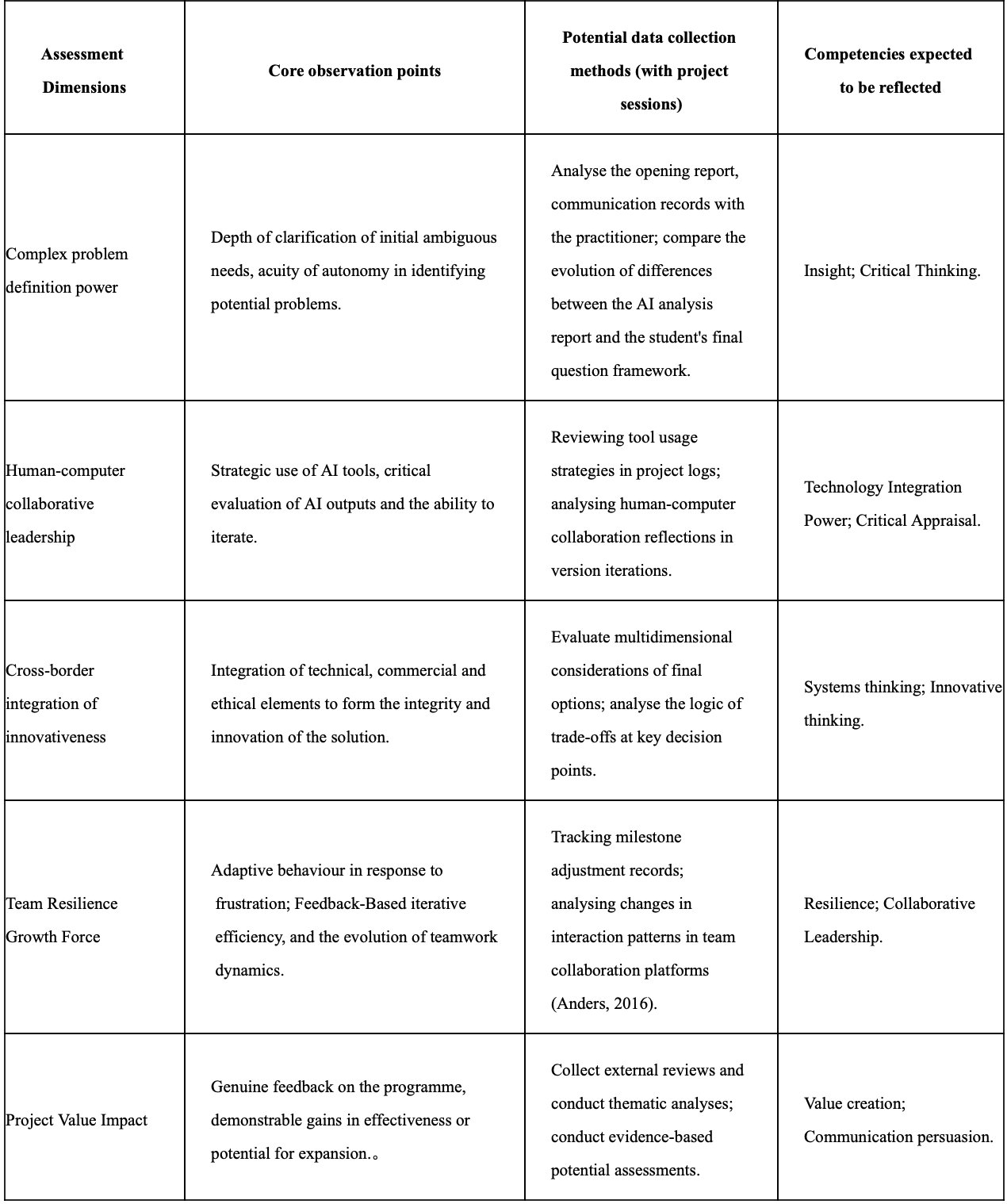
This framework is intended to offer an assessment perspective that transcends conventional grading—one that is more process-aware and closer to the educational essence. It could provide nuanced feedback for enhancing teaching and learning, while also furnishing students with a competency profile that documents their distinctive developmental journey. Such a profile would help articulate, in a more concrete and compelling manner, the profound impact of the college’s educational approach—for instance, during student admission or professional placement.
5. Case Study: Syntegrative practices of the “Chi Forest” project
The concept of “Dynamic Competency Mapping” is not merely theoretical; it is deeply rooted in the rich, practice-based ecosystem of the college’s syntegrative projects. A prime example is the real-world collaboration between XJTLU Entrepreneur College (Taicang) and Chi Forest. This case clearly illustrates how a thoughtfully designed syntegrative project naturally generates process-based data for assessing higher-order competencies, offering a tangible and vivid validation of the assessment framework proposed earlier.
(1) Project Anchor: From Real Challenge to Learning Catalyst
The project originated from two pressing business challenges faced by Chi Forest: the operational complexity of campus sales channels and the urgent need for brand rejuvenation among younger consumers. This represented a classic “fuzzy front-end” problem—ill-defined and open-ended. Rather than providing predefined solutions, the company translated its core KPIs—such as improving channel efficiency and strengthening brand engagement—into a series of explorable sub-problems: inventory forecasting, consumer journey mapping, digital campaign design, and other areas. This “demand import” phase itself served as an initial assessment of students’ complex problem-defining capability. Students were tasked with identifying and framing specific, researchable questions within a broad business context—directly aligning with the course’s first core objective: to formulate relevant and researchable questions for an industry project.
(2) Process Evolution: Making Competencies Visible Through Structured Collaboration
The project was structured into staged tasks, each designed to cultivate and make observable specific competencies.
In the Research Plan Development phase, students moved from individual brainstorming to team consensus, producing a Team Assumption Map and a Research Design Matrix. This process required integrating diverse viewpoints and translating vague hypotheses into testable research pathways. The resulting documents and digital collaboration traces provide direct evidence for evaluating early indicators of team resilience and cross-domain integrative innovation—the latter reflected in the interdisciplinary selection of research methods.
During the Feasibility Assessment and Collaboration phase, students conducted structured peer reviews, drafted implementation plans, and wrote individual reflections. Peer review records reveal their capacity for critical thinking and constructive feedback, while personal reflections illuminate how students connect their individual contributions to broader project goals. These outputs serve as clear markers of collaborative leadership (here, human-to-human coordination) and perceived project value impact—key dimensions of the competency framework.
(3) Deliverables: Integrated Solutions as Evidence of Synthesized Competence
The final project outcome was not a single report but a comprehensive solution set, including an operations plan, an interactive campus vending machine map, a sales analytics dashboard, a UI prototype, and a marketing campaign package. These deliverables collectively demonstrate cross-domain integrative innovation, as students wove together market insight, data analysis, technological application, design thinking, and business strategy. For instance, proposing an interactive vending machine map required understanding user behavior (insight), applying spatial and data visualization tools (technical integration), and aligning the solution with consumer experience goals (innovative thinking). The actual adoption of project proposals and feedback from Chi Forest provided a robust external measure of project value impact.
(4) Deeper Insight: Cultivating ‘SMART’ Talent Beyond Skill Training
A particularly revealing moment occurred during a site visit to Chi Forest’s Taicang production base. While fully automated production lines showcased advanced “hard” technology, the plant manager emphasized the ongoing need for what he termed ”SMART” employees—personnel who combine strategic thinking, managerial coordination, and technical understanding to oversee quality control, maintenance, logistics, and other critical functions. This observation underscores a key reality highlighted by the “Great Compression Effect”: purely procedural roles will continue to be streamlined, whereas individuals equipped with problem-solving agility, systems-management ability, and cross-context communication skills will become increasingly valuable.
The success of the Chi Forest project exemplifies how syntegrative education systematically addresses this emerging talent demand. Through the iterative cycle of demand import → pedagogical redesign → educator empowerment → value creation, the project not only addressed concrete business needs but also facilitated the development and validation of students’ higher-order competencies in an authentic context. The process artifacts, collaboration logs, iterative versions, and final outcomes generated throughout the project collectively form a rich, dynamic competency development map. This case affirms that integrating a structured, process-sensitive assessment system with high-quality syntegrative projects is not only feasible but also a powerful means of making the formative value of education—and the distinctive capabilities of students—visible, demonstrable, and meaningful.
6. Conclusion: Firming the path of practice in theoretical reflection
Viewed through the lens of the emerging organizational theory of the "Great Compression Effect," the educational logic underpinning the syntegrative model at XJTLU Entrepreneur College (Taicang) demonstrates both notable resilience and foresight. It moves beyond merely adapting to technological disruption to fundamentally cultivate the higher-order human capabilities that will become increasingly scarce—and decisive—in an AI-augmented world. This paper has sought to reframe and reaffirm the college's established practices by applying a new theoretical perspective. The exploratory discussions on model evolution and assessment presented here are intended as academic provocations—their primary value lies in stimulating further dialogue and iterative experimentation. The enduring vitality of education, after all, is sustained through continuous, grounded practice. The syntegrative ecosystem at XJTLU Entrepreneur College (Taicang) offers fertile ground for such renewal (Xi & Zhang, 2025). Moving forward, the central challenge—and opportunity—for educational practitioners will be to build upon this foundation, ensuring that every project becomes a crucible in which students forge the distinctive, irreplaceable mindsets needed to navigate and shape the future.
Reference List
Autor, D. H., Levy, F., & Murnane, R. J. (2003). The skill content of recent technological change: An empirical exploration. Quarterly Journal of Economics, 118 (4), 1279–1333. https://doi.org/10.1162/003355303322552801
Dubay, C. M., & Richards, M. B. (2024). Leveraging artificial intelligence in project-based service learning to advance sustainable development: A pedagogical approach for marketing education. Marketing Education Review, 34 (4), 307–323. https://doi.org/10.1080/10528008.2024.2411975
Holstein, K., McLaren, B. M., & Aleven, V. (2019). Designing for complementarity: Teacher and student needs for orchestration support in AI-enhanced classrooms. In S. Isotani, E. Millán, A. Ogan, P. Hastings, B. McLaren, & R. Luckin (Eds.), Artificial intelligence in education (pp. 157–171). Springer. https://doi.org/10.1007/978-3-030-23204-7_14
Wu, S., Liu, Y., Ruan, M., Chen, S., & Xie, X.-Y. (2025). Human–generative AI collaboration enhances task performance but undermines human intrinsic motivation. Scientific Reports, 15 (1), Article 15105. https://doi.org/10.1038/s41598-025-98385-2
席酉民, & 张晓军. (2025). 融合式教育: 西交利物浦大学的探索. 高等工程教育研究, (4), 10-18.
Other Charts
Figure 1. Chi Forest business and operations student group programme
Figure 2. Chi Forest business and operations student group programme
Figure 3. XJTLU Innovation in the Learning Process
.jpg)


